PP woven bag manufacturing in China 2026
18/07/2026In 2026, the global industrial packaging sector is undergoing a profound shift toward automation, waste reduction, and smart material engineering. At the center of this evolution is China, which remains a massive global force in PP woven bag manufacturing. Valued within a rapidly growing multibillion-dollar global market, Chinese factories are transforming how WPP bags, poly woven bags, and PP bags are produced and distributed worldwide.
For international procurement managers, distributors, and bulk buyers, understanding the current state of polypropylene woven bags manufacturing in China is key to navigating the 2026 supply chain.
1. Key Manufacturing Hubs in China (2026)
China’s production capacity for woven poly bags is anchored in highly specialized provincial clusters. These regions leverage deep supply chains, local raw material processing, and advanced logistical networks to handle immense order volumes:
-
Cangnan County, Zhejiang Province: Often referred to as a core capital for plastic weaving, this area hosts major production facilities like Beijing Silk Road Enterprise Management Services Co.. It specializes in high-volume composite packaging, BOPP laminated bags, and high-precision gravure printing.
-
Shandong Province (Zibo & Jiaozhou): Home to heavy-duty industrial giants like Zibo Yundu Plastic Products and Qingdao Zhongbang (ZB) Packaging, this region is the go-to hub for high-load PP bags used for cement, chemicals, and industrial minerals.
-
Liaoning & Wenzhou Clusters: These areas dominate in agricultural polypropylene sacks, supplying bulk structural packaging for regional grains, rice, and fertilizer distribution.
2. High-Speed Automation: The Move Toward “Data-Driven” Production
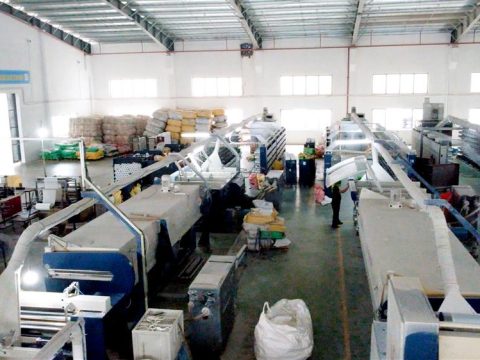
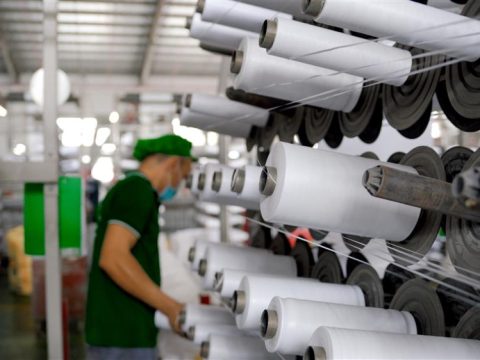
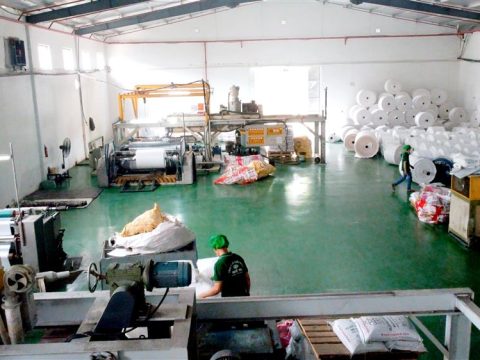
The most significant trend defining Chinese WPP bag manufacturing in 2026 is the rapid transition from manual or single-machine operations to fully integrated, intelligent automation. Faced with rising domestic labor costs and stringent global quality demands, Chinese factories have retooled their lines.
Fully Automated Inner Lining Integration
Historically, inserting a protective PE liner into an outer poly woven bag was a bottleneck that required intense manual labor. In 2026, Chinese facilities are widely adopting fully automatic cutting, sewing, and inner-lining integrated machines. This equipment performs automatic insertion, positioning, and heat sealing in one continuous flow, cutting manufacturing defects and guaranteeing the moisture-proof barriers necessary for food-grade and chemical applications.
All-Servo Intelligent Machinery
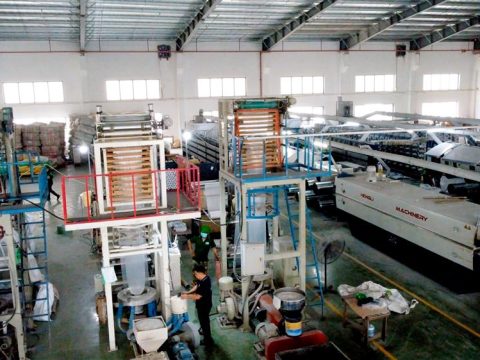
Exhibitions like CHINAPLAS 2026 showcase advanced all-servo bag-making machines running on integrated bus control systems. Utilizing dozens of independent servo motors and HMI connectivity, these lines achieve speeds up to 250 cuts per minute while slashing production waste down to less than 2%. Production is no longer dependent on manual calibration; it is completely data-driven.
3. Emerging Trends in Bag Design & Material Optimization
To satisfy changing corporate mandates, Chinese manufacturers have prioritized two core pillars in 2026: lightweighting and advanced aesthetics.
-
High-Strength, Low-GSM Fabrics: Manufacturers are optimizing polymer formulations and tape extrusion techniques to reduce the fabric’s GSM (grams per square meter) without sacrificing load-bearing capacity. This lowers material consumption, minimizes carbon footprints, and reduces international freight costs.
-
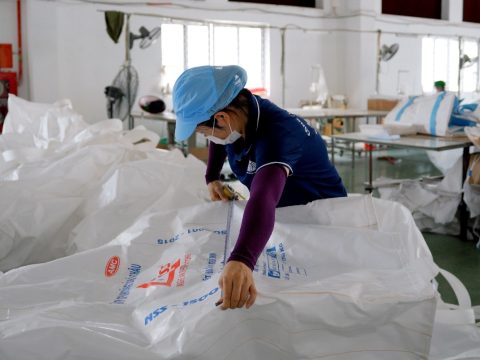
High-Definition Branding: The demand for retail-ready BOPP laminated PP woven bags has surged. Factories are utilizing rotogravure and flexographic printing to achieve photo-quality, vibrant graphics that make products like pet food and agricultural seeds pop on shelves while remaining highly scratch-resistant.
-
Eco-Conscious Formulations: In alignment with international plastic regulations, factories are heavily integrating PCR (Post-Consumer Recycled) PP and developing easily recyclable single-polymer laminated options to meet international green targets.
4. Technical Specifications Matrix (2026 Standard Export Quality)
| Feature | Specifications Range | Ideal Application |
| Material | 100% Virgin Polypropylene (or custom rPP blends) | Food, Chemicals, General Cargo |
| Fabric Weight | 55 GSM to 120+ GSM | Lightweight grains to heavy minerals |
| Weave Mesh | 10×10, 11×11, 12×12, to 14×14 | Controlled sifting and breathability |
| Denier Rating | 600D to 1500D | Puncture and burst resistance |
| Special Features | UV Stablized, Gusseted, Valve-type, PE Liner | Extended outdoor storage, automated filling lines |
Sourcing Considerations: The 2026 Landscape
While China’s scale and high-speed multi-servo infrastructure make it a powerful hub for purchasing bulk polypropylene woven bags, global procurement teams must balance these benefits against macroeconomic factors. Fluctuating input costs, domestic structural upgrades, and shifting international trade tariffs have led many Western and regional buyers to explore a diversified “China Plus One” blueprint.
As a result, neighboring manufacturing powerhouses like Vietnam have become highly competitive alternatives. Vietnam offers advanced automated production lines (utilizing European Starlinger technology) combined with zero-duty access through massive trade networks like the EVFTA and CPTPP.
Are you evaluating suppliers for an upcoming industrial or agricultural packaging project?
Contact our technical export team today to receive side-by-side specification sheets, up-to-date container freight estimations, and quotes tailored to your automated packing lines.
Visit vietnamjumbobag.com today to browse our full 2026 catalog, download technical data sheets, and request a factory-direct container quote to your nearest Australian port.
- Dien – Export Manager: +84 98 549 5345 (Whatsapp, Wechat, Line, Viber, Kakao talk)
- Email: Dien@napco.com.vn
- Website: https://vietnamjumbobag.com/